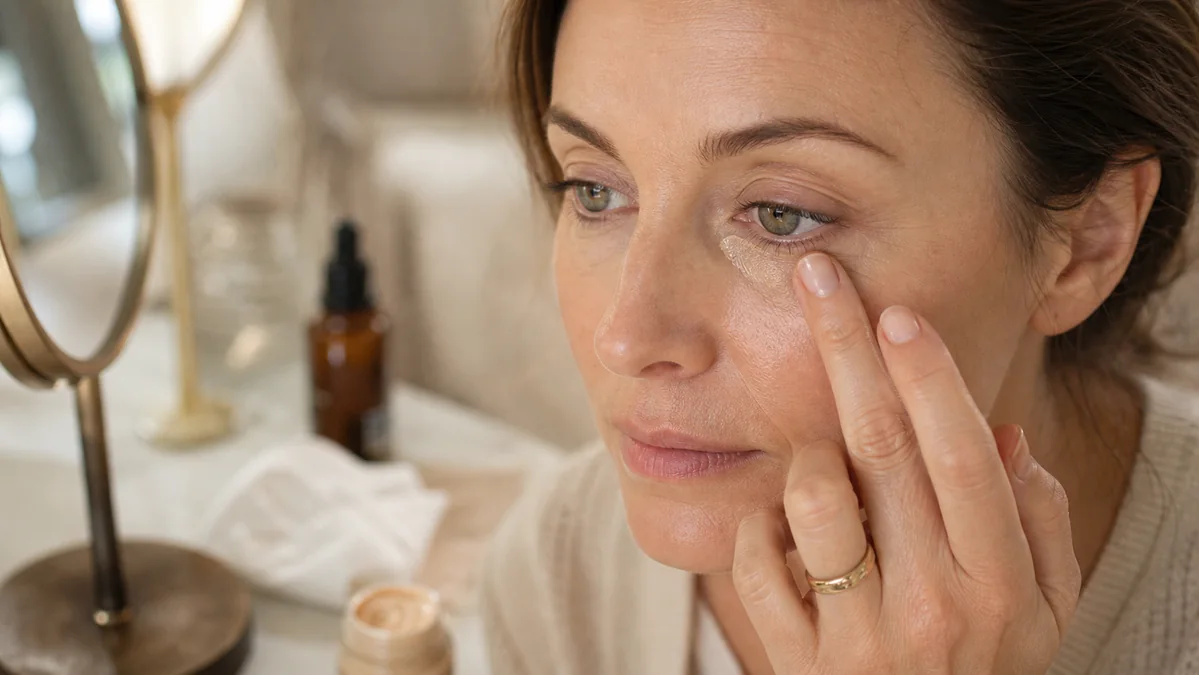
Every under-eye has movement and lines, so no concealer can make the area permanently flat. The useful goal is smaller: prevent excess product from collecting in the fold, keep the surface comfortable, and make a midday correction possible without adding a dry cake of powder.
Quick answer: Use less eye-area skin care, place concealer on the darkest shadow rather than across every line, tap on a very thin layer, look straight ahead, remove product that gathers in the crease, and set that crease with the residue on a small powder brush.
Identify when the crease appears
Apply your usual routine and check at 5 minutes, 30 minutes, and 4 hours. A crease that appears immediately points to excess product or placement in a moving fold. One that appears after commuting may involve heat, oil, or rubbing. A dry cracked finish suggests too much powder, a matte formula, or dehydrated preparation.
Photograph both eyes in the same light. Do not judge from a magnifying mirror that makes normal skin texture look like a product emergency.
Reset the skin-care layer
Use a small amount of familiar moisturizer under the eyes and keep it off the lash line. Let sunscreen and skin care settle before makeup. If the area remains visibly wet, press a clean tissue lightly over the surface; do not rub.
More eye cream is not always the fix for dryness. A rich moving layer can carry concealer directly into folds. Treat persistent dryness or irritation through the underlying skin-care routine rather than burying it under pigment.
Map the actual shadow
Face a window and look straight ahead. The darkest area is often near the inner corner and along a short trough, not the entire semicircle under the eye. Place one or two tiny dots only on that shadow.
Keep product away from the lash line and outer smile lines unless discoloration there truly needs correction. Every unnecessary millimeter is another place for product to travel.
Apply one thin layer
- Warm a pin-sized amount on the back of a clean hand.
- Pick up a trace with a ring finger or small brush.
- Tap over the darkest area without dragging the skin.
- Blend the edge outward while leaving the center slightly more opaque.
- Wait 30 seconds, then add another pinpoint only if darkness still distracts.
This preserves coverage where it matters and keeps the flexible zones light. A thick triangle may photograph brightly for a minute but creates more material to fold later.

Remove the crease before powder
Look up, then straight ahead, allowing the eye to make its natural fold. Use a clean fingertip or the corner of a sponge to tap out any line of collected product. This is the material that would otherwise be locked in place by powder.
Do one eye at a time. If you smooth both and then search for a brush, the first eye may crease again before setting.
Set the fold, not the whole under-eye
Load a small soft brush with translucent powder, tap off nearly all visible excess, and press the remaining trace over the line that moves. Do not sweep back and forth. Leave the lower outer area unset if it stays stable.
For dry skin, try no powder on one eye. Wear both sides for four hours. If the unpowdered side creases but remains easy to tap smooth while the powdered side looks cracked, your practical answer may be a quick midday tap rather than more setting.
Run a one-eye comparison
Keep formula and tool the same. On the left eye, use the current amount. On the right, use half the concealer and powder only the fold. Check both at the same three times.
The test changes amount and setting together only to establish whether the lighter strategy is promising. On the next wear, isolate the winning variable: equal concealer with different powder, or equal powder with different concealer.
| Result | Next test |
|---|---|
| Immediate crease | Move placement away from fold and halve amount |
| Smooth but too sheer | Add pigment only to darkest shadow |
| Dry by lunch | Reduce powder or choose a more flexible formula |
| Slides after commute | Use less eye cream and allow more settling time |
| Burning or swollen | Remove product and stop using it |
Correct it at midday without buildup
Wash or sanitize hands and let them dry. Press away moisture with a clean tissue. Tap the collected concealer out of the fold. Add no more product unless coverage is visibly missing; if needed, use the residue from a tiny dot, then set only the repaired line.
Layering powder directly over oil and creased pigment creates thickness. Always smooth first, then decide whether anything needs adding.
Keep eye-area safety separate from wear
Stop immediately if concealer, powder, or an applicator causes eye irritation. Avoid makeup while an eye infection or surrounding inflammation is active, and discard eye cosmetics used during the infection as FDA guidance recommends. Use products only in the areas their labels allow.
Persistent swelling, pain, discharge, vision changes, or irritation after removal needs medical attention. Creasing is cosmetic; eye symptoms are not a setting problem.