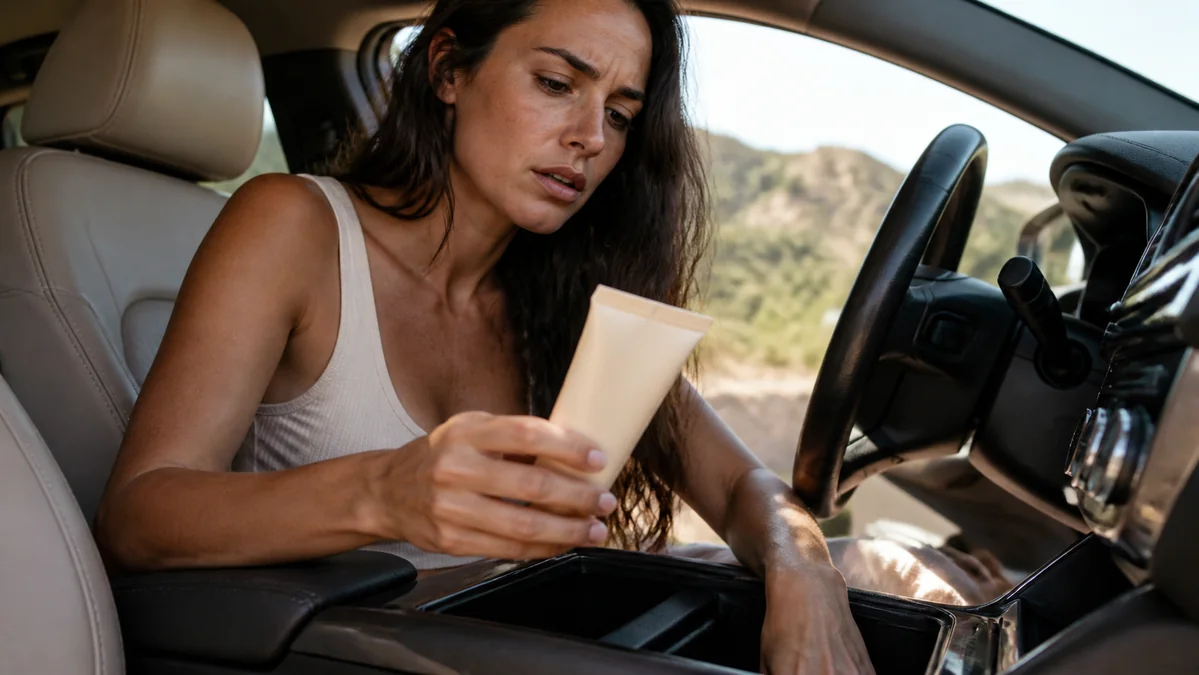
A parked car can become far hotter than normal room storage, and sunscreen labels direct users to protect the product from excessive heat and direct sun. There is no reliable household test that confirms the SPF of a heat-exposed bottle.
Practical decision: if exposure was prolonged or repeated, the package is damaged, the formula has changed, or you cannot reconstruct what happened, replace the product before relying on it for meaningful sun exposure.
Do not use a questionable bottle as the only protection while deciding. Move to shade, cover skin, wear a hat and sunglasses, or obtain a fresh sunscreen.
Record the exposure before it fades from memory
Note:
- Where the sunscreen sat: dashboard, console, glove box, trunk, or bag.
- Whether the car was parked in direct sun.
- Approximate outside conditions and duration.
- Whether this happened once or throughout the season.
- Whether the container was open, leaking, or under pressure.
You do not need a false precision temperature estimate. The pattern “stored in the car for weeks” is more concerning than a brief transfer in a closed bag.
Read the product's own storage directions
Check the Drug Facts and package insert. FDA sunscreen labeling guidance includes protecting the product in its container from excessive heat and direct sun. Manufacturers may provide additional storage limits or instructions for that formulation.
Follow the most specific valid instructions on your product. Online anecdotes about another brand or format do not establish stability for yours.
Let the container cool safely
Move the bottle indoors and out of direct sunlight. Let it return naturally toward room temperature before opening. Do not freeze it, immerse it in ice water, microwave it, or attempt to “reverse” heat exposure with extreme cooling.
For an aerosol, keep it away from sparks, flames, and heat and follow all flammability and pressurized-container warnings. A bulging, leaking, or damaged aerosol should not be tested near the face.

Inspect the package
Look for:
- swelling, warping, cracks, or a distorted seam;
- leakage around the cap, pump, or crimp;
- a cap that no longer closes securely;
- faded or unreadable directions and expiration information;
- corrosion, rust, or aerosol damage.
Discard a product with compromised packaging. Transferring it into a new unmarked container hides the instructions and does not restore formula integrity.
Inspect the formula without trusting appearance alone
When the package is safe to open, dispense a small amount onto a clean disposable surface. Compare it with your memory of the product.
Watch for separation, watery discharge, clumps, graininess, unusual thinning or thickening, color change, or a different odor. A stick may become misshapen or apply in uneven pieces.
Any change is a strong reason to replace it. A normal appearance, however, cannot prove that a product preserved its labeled performance after severe storage.
Choose an action from the evidence
| Situation | Decision |
|---|---|
| Package leaked, warped, swelled, or cracked | Discard safely and replace |
| Formula separated or changed odor, color, or texture | Stop using and replace |
| Aerosol was heat exposed or container is damaged | Follow hazard label; do not test near flame or face |
| Bottle lived in the car repeatedly | Replace rather than depend on uncertain storage |
| Exposure was brief, package and formula unchanged | Check manufacturer guidance and label; use judgment |
| High-stakes outdoor exposure is imminent | Use a fresh product plus shade and clothing |
The cost of replacement should be weighed against the inability to verify protection at home.
Do not attempt a rescue
Do not repeatedly shake a separated emulsion until it looks normal and assume its protection returned. Do not mix it with another sunscreen, moisturizer, or foundation. Do not refrigerate it as a repair. Do not reserve it for children or body areas simply to finish the bottle.
If it is unsuitable for reliable sun protection, remove it from the routine.
Build a safer car-day system
Carry sunscreen in the bag that leaves the vehicle with you. For outdoor work or travel:
- use an insulated bag only if it follows product guidance and does not freeze the formula;
- keep the product shaded and away from windows;
- bring a smaller original retail container when available;
- set a reminder to remove the bag at the destination;
- keep a hat, sunglasses, and covering clothing as backup.
A backup bottle stored in a climate-controlled workplace or home is more dependable than one permanently kept in the glove box.
Check date and batch information
Review the expiration date and any manufacturer instructions. In the United States, products without an expiration date may be subject to applicable shelf-life rules, but heat exposure can make the printed date a poor reason to ignore visible damage.
Keep the lot number and photos if reporting a product quality concern to the manufacturer or FDA.
Respond to a skin problem
Stop using the sunscreen if it causes a new persistent rash, burning, swelling, blistering, or other concerning reaction. Wash it off gently and seek medical advice when symptoms are significant or do not improve. Report serious or quality-related problems through appropriate manufacturer and regulatory channels.
Store the replacement deliberately
Keep the next sunscreen according to its label, away from excessive heat and direct sun. At the start of hot weather, check every bottle in bags, cars, sports kits, and strollers. A five-minute storage audit is more useful than trying to calculate the unknown SPF of a cooked product later.