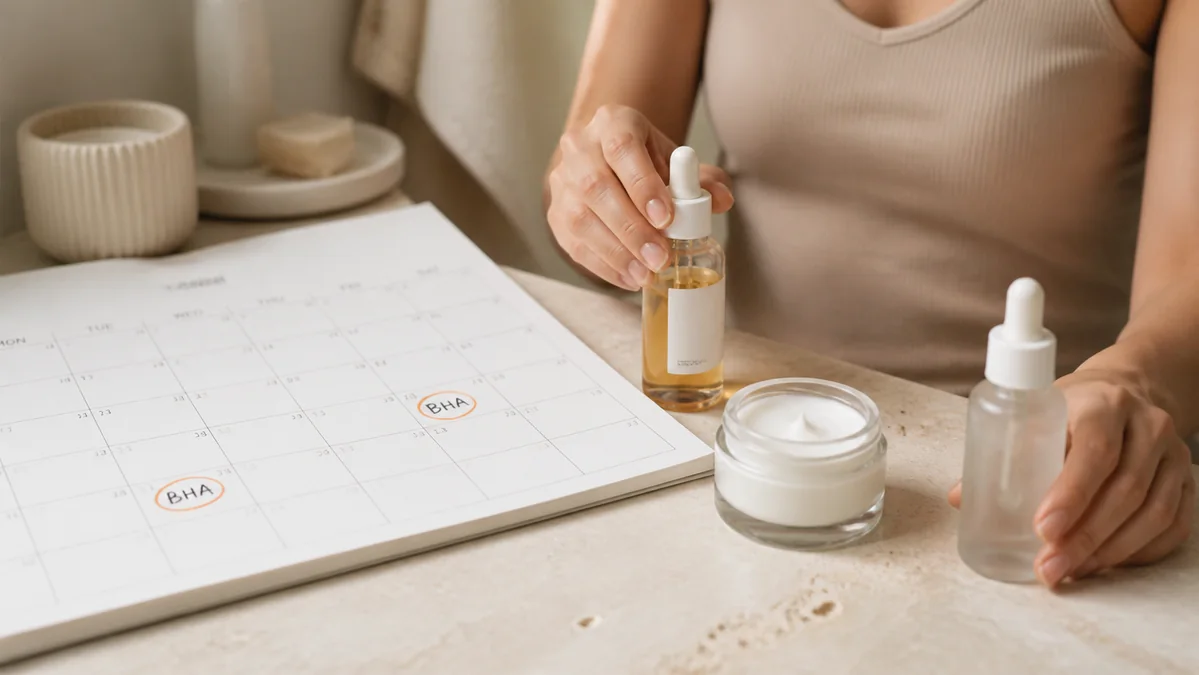
Chemical exfoliation becomes confusing when the routine starts with an acid toner, a peel pad, a scrub, and a retinoid all at once. Texture may feel temporarily smoother, but burning and flaking leave no way to identify the culprit. A useful beginner trial is deliberately narrow.
Quick answer: Choose one AHA or one BHA product, patch test it, then use it one night a week for the first two weeks. Keep cleanser, moisturizer, and sunscreen unchanged. Do not stack another exfoliant on the test night.
Exfoliation is optional. If your skin is painful, cracked, sunburned, or reacting to another product, wait until the barrier feels normal before beginning.
Pick the acid by the job, not the trend
AHAs include glycolic and lactic acid. They are commonly chosen for surface concerns such as rough-feeling texture or uneven-looking tone. BHA on cosmetic labels usually means salicylic acid and is commonly selected when oil and clogged-looking pores are the main concern.
That distinction is a shopping filter, not a guarantee. Formula strength, pH, frequency, the rest of the routine, and your skin all affect tolerability. Choose one leave-on product with clear directions instead of buying both categories for comparison.
Check whether today is a bad start day
Delay the trial if you recently shaved or waxed the area, have open blemishes, active dermatitis, sunburn, or stinging from ordinary moisturizer. Check current medications and prescriptions too. The AAD notes that retinoids can make skin more sensitive; aggressive exfoliation alongside them may worsen dryness or irritation.
If a dermatologist prescribed an acne or pigmentation regimen, ask before inserting a cosmetic acid. A medical plan should not be rearranged around an internet routine.
Patch test the exact formula first
Follow the product label and the AAD's cautious testing principle before full-face use. Apply to a small, discreet area as directed and repeat for the recommended test period. A quiet patch does not promise that the face will tolerate frequent use, but it can reveal an obvious reaction before broader exposure.
Stop for swelling, hives, blistering, or persistent burning. Wash off a rinse-off product immediately if the label time has passed or discomfort becomes significant.
Run this four-week schedule
- During week 1, use the exfoliant on one evening only.
- During week 2, repeat on the same weekday if skin returned fully to baseline.
- During weeks 3 and 4, remain at once weekly if there is dryness; consider twice weekly only when the label permits it and skin stayed calm.
- Leave at least two recovery nights between applications.
- Do not increase amount and frequency in the same week.
On the chosen night, cleanse gently, pat dry, apply only the label-directed amount, and moisturize. Skip scrub brushes, washcloth friction, peel pads, retinol, and another acid.

Protect AHA-treated skin from sun
FDA guidance says topical cosmetic AHAs may increase sun sensitivity and the possibility of sunburn while used and for up to a week after stopping. Follow the product warning. Use broad-spectrum sunscreen, wear protective clothing, seek shade, and limit intense exposure rather than treating nighttime application as complete protection.
Daily sun protection also makes the trial easier to read. A weekend sunburn can resemble product irritation and erase any useful comparison.
Separate sensation from a warning
A brief mild tingle can occur with some formulas, but pain is not a performance metric. Persistent burning, bright redness, shiny tight skin, tenderness, cracking, swelling, hives, or blistering mean stop. Rinse if appropriate, pause exfoliation, and return to products that do not sting.
Seek prompt care for trouble breathing, facial or eye swelling, severe pain, or extensive blistering. Contact a dermatologist if irritation does not improve after stopping or repeatedly returns at low frequency.
Do not use breakouts as permission to escalate
Calling every new bump a purge can keep an unsuitable product in place. Track location, timing, itch, tenderness, and whether bumps occur where you do not usually break out. Do not respond by adding another acid or scrubbing harder.
For acne that is deep, painful, scarring, or persistent, an evidence-based treatment plan from a dermatologist is more useful than progressively stronger cosmetic exfoliation.
Keep recovery nights genuinely plain
Use a gentle cleanser, moisturizer, and nothing added for novelty. If moisturizer stings, the routine is not ready for another exfoliation night. Avoid fragranced masks and physical scrubs during the trial because they add irritation without helping you evaluate the acid.
The AAD advises matching exfoliation method to skin type and being especially gentle with dry, sensitive, or acne-prone skin. More friction is not a substitute for a suitable formula.
Evaluate at day 28
Compare the same area in similar daylight. Ask whether roughness, visible congestion, or makeup texture changed without ongoing sting or peeling. Also ask whether sunscreen and moisturizer still feel normal. If the answer is unclear, do not increase frequency merely to force a result.
| Observation | Next move |
|---|---|
| Skin is calm and the target concern improved | Keep the current frequency |
| No change, but skin is comfortable | Finish a longer label-consistent trial before escalating |
| Tightness or flaking lasts into recovery days | Pause, then restart less often if appropriate |
| Burning, swelling, hives, or blistering | Stop and seek medical advice as severity requires |
| New painful or scarring acne | Ask a dermatologist for a treatment plan |
Avoid the hidden exfoliant pileup
Scan every product used that day. Acid cleansers, exfoliating pads, acne treatments, resurfacing masks, retinoids, and facial scrubs can overlap even when only one bottle says “peel.” Hair-removal products and recent procedures can add sensitivity too.
Keep a one-line calendar note with the product, date, and next-morning comfort. That record is more useful than trying to remember whether last Tuesday's tightness happened before or after a second application.